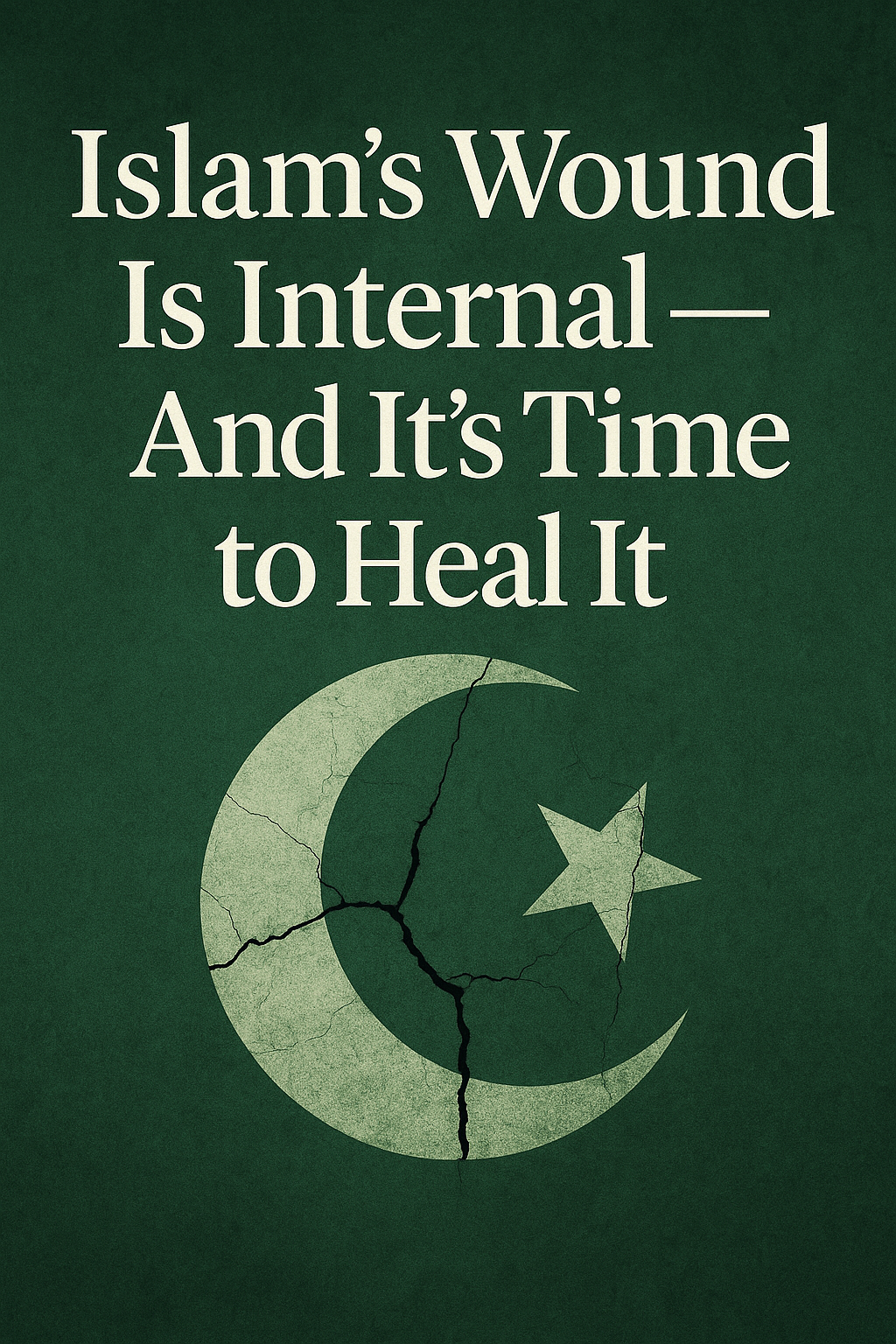
Form, Essence, and the Soul of Islam: Rethinking What Truly Matters
In my personal journey as a Muslim, I’ve found myself questioning a foundational yet often unquestioned idea: Is the physical form of prayer more important than the intention behind it? If getting the details of prayer form wrong could mean being outside the fold of Islam, then why wasn’t it laid out explicitly in the Qur’an?
This isn’t rebellion — it’s sincere reflection. I believe intention, presence, and connection with God are more important than perfect performance. That doesn’t mean form is meaningless. Form has a role — especially when we pray in groups, teach others, or seek spiritual discipline. But to say the form alone determines who is Muslim and who is not feels like a distortion of what Islam was meant to be.
The Missing Instructions — Or Was It Meant That Way?
The Qur’an commands prayer clearly:
“Establish prayer…” (Surah Al-Baqarah 2:43)
“Indeed, prayer has been decreed upon the believers a decree of specified times.” (Surah An-Nisa 4:103)
But nowhere does it say: pray exactly five times a day, with four rak’ahs for dhuhr, two for fajr, or precisely how to bow and sit. Instead, the form of prayer was embodied in the life of the Prophet Muhammad — witnessed by those around him.
And that’s where my second reflection comes in: the Prophet lived in a specific time, with specific companions who could see and copy him directly. We can’t. We are told to follow thousands of narrations, filtered through centuries, debated by schools, imams, and scholars we never met.
If physical form was that essential, why wouldn’t God preserve it in the Qur’an — the one book He promised would never be changed?
Maybe it wasn’t forgotten. Maybe it was a Divine decision to keep form flexible, and the spirit eternal.
What the Prophet Himself Said
There are narrations where the Prophet warned:
“Do not write down anything from me besides the Qur’an. Whoever has written anything besides it should erase it.” (Muslim)
And yet, generations later, Hadith collections were compiled by humans — sincere, but fallible — long after the Prophet passed. Scholars like Imam Malik and Al-Ghazali openly acknowledged the presence of weak and fabricated narrations.
Was the Prophet himself worried that his example might be misused or misunderstood if it replaced the direct clarity of the Qur’an?
It seems possible — even likely.
The Sufi Path — A Tradition of Trusting the Heart
I found refuge in the path of Sufism — or more precisely, the inner path of love, surrender, and presence. The great Sufis never denied the outer form — but they never worshipped it either. For them, the heart’s connection with the Divine was the true prayer.
Rumi said:
“The ritual prayer is a preface until you fall prostrate in the fire of love.”
Rabia al-Adawiyya declared:
“I do not worship for fear of Hell or desire for Paradise, but because He is worthy of worship.”
Ibn Arabi wrote:
“My heart has become capable of every form… I follow the religion of Love.”
To these souls, God was not a strict examiner of technicalities, but the Beloved, the Light, the Presence that fills the entire being.
The Danger of Form Without Spirit: Fundamentalism
When form becomes everything, and the heart is ignored, religion turns to fundamentalism. We see this today — not just in headlines, but in communities, families, and even on prayer mats:
- People declaring others non-Muslim over minor differences
- More focus on the length of your trousers than the depth of your compassion
- Obsession with rules, and neglect of the soul
The damage of fundamentalism has, in many ways, been far worse than that caused by external enemies. While colonialism and Islamophobia hurt the political body of Islam, fundamentalism wounded its soul.
Historically:
- Sufi saints like Hallaj were executed not by non-Muslims, but by Muslims who feared their spiritual insight.
- Rumi’s tomb was attacked by those who couldn’t understand his language of love.
- The Taliban, ISIS, and others have destroyed the beauty of Islam while claiming to protect it.
Yet the Qur’an warns us:
“Woe to those who pray — but are heedless of their prayer.” (Surah Al-Ma’un 107:4–5)
“They have taken their religion as amusement and play, and the life of this world deceived them.” (Surah Al-A’raf 7:51)
And the Prophet said:
“Perhaps a fasting person gets nothing from his fast but hunger; and a praying person gets nothing from his prayer but fatigue.” (Ibn Majah)
Real Islam was never meant to become this.
The Contradiction Within Islam
Yes, there is a contradiction — or at least a painful tension — within the Muslim world:
- On one side, those who emphasize outer form to the point of exclusion and judgment.
- On the other hand, those who seek inner truth and connection are sometimes accused of being too free or unorthodox.
The Qur’an emphasizes diversity:
“To each of you We prescribed a law and a method… If Allah had willed, He would have made you one nation [unified in form].” (Surah Al-Ma’ida 5:48)
But some sects insist: Only our way is right, creating more division than unity. If Islam was meant to be universal, eternal, and merciful, why would it be so rigidly locked into historical interpretations that even the Prophet did not codify in writing?
So What Do I Believe?
I believe:
- Form matters, especially when practiced in a community, but it is not what makes one a Muslim.
- Intention (niyyah) and presence are higher than mechanical rituals.
- The Qur’an is the eternal compass, and anything beyond it must not replace its light.
- The Prophet was not a lawmaker who left us confused, but a mirror of Divine love, whose legacy was intended to awaken hearts, not trap minds.
I follow Islam not through sects or inherited filters, but through a direct, sincere seeking of the Divine, with the Qur’an in one hand, and my heart open to God’s guidance.
This is not rebellion. This is a return.
This is not a deviation. This is devotion.
Leave a Reply