Since the dawn of human consciousness, one question has echoed across religions, philosophies, and scientific inquiry: If God knows everything, how can we truly have free will? And if the future is already known, why are we judged for our actions?
At first glance, this seems to be a paradox. If God is omniscient, then the future is predetermined. And if it is predetermined, are we not merely actors following a script? Yet, if our choices are truly free, then how can they already be known?
To make sense of this, let us step into a new metaphor — one rooted in ancient mysticism, cutting-edge science, and a deep personal reflection.
The Library of God: A Soul’s Infinite Books
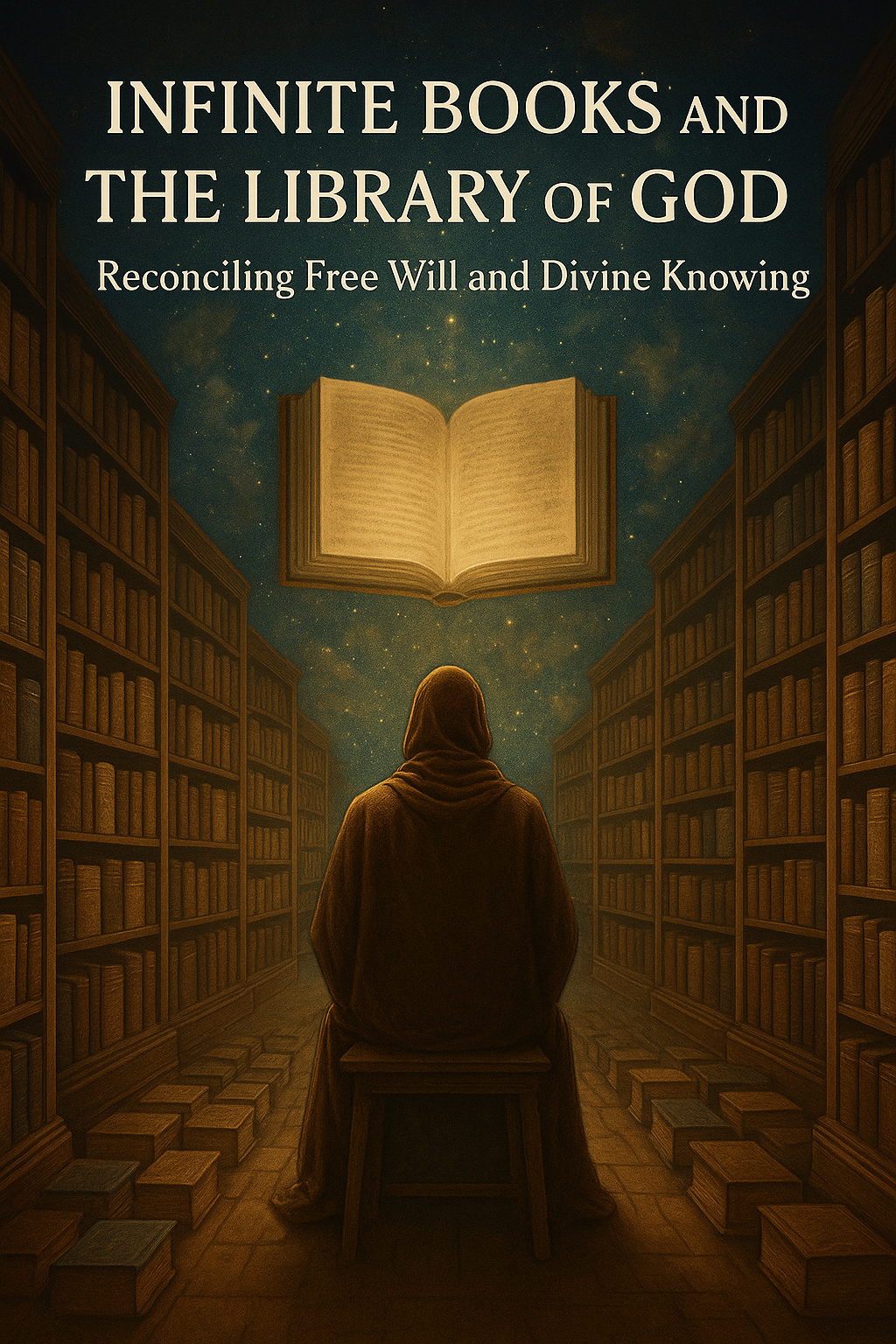
Imagine each soul as a being sitting in a vast, eternal library — the Library of God. Before you lies not one book of your life, but an infinite number of books, each telling a different story. Every path you could ever take, every choice you could ever make, already exists as a completed narrative. And God — or the Source — knows all of them.
These are the records of the soul — akin to the Akashic Records, described across mystical traditions as an etheric field storing every potential and actual event. Your lived experience is the observation of one such book unfolding, but the others remain equally present.
Time, in this view, is not linear. As you move through the pages of your life, God does not force your hand — you, the soul, are simply choosing which book to open. And all of them are already written, because from God’s view, there is no time.
This resonates with the concept of eternal now: All stories exist at once, and the soul is a particle of the Divine living different lives across dimensions and timelines. These stories are not created in time — they just are, much like God is. They exist in the same timeless state as the Source itself.
Justice, Karma, and the Sacred Agreement
But then, why do we speak of punishment and reward?
In this framework, judgment is not imposed onto us — it is an agreement we made with the Source. A karmic and sacred bond. Before choosing a life, a soul may agree to its own laws of growth. The “reward” or “punishment” is not divine retribution — it is simply the natural unfolding of consequences within the narrative we chose.
And when the journey ends, we return to the Nothingness of God — not as an outside being judging us, but as the only awareness that remains. The final realization is that there is no other. The illusion of separation dissolves. In other words: “When you go there, it will be only you there and no one else.”
This is mirrored in Sufism, where the journey ends in fana — the annihilation of the self in the Beloved. The drop returns to the ocean and realizes it was always the ocean. Rumi captures this beautifully: “You are not a drop in the ocean. You are the entire ocean in a drop.”
Philosophical and Scientific Echoes
This metaphor of infinite books fits into modal realism — the idea that every possible world exists as a real world, and we happen to experience one. It also harmonizes with Plato’s Forms: that the Ideal versions of all realities exist outside time, and our world is a shadow of one such form.
In science, this view aligns with the Many-Worlds Interpretation of quantum mechanics, where every decision branches into a parallel universe. And in the block universe theory, all past, present, and future events exist simultaneously; we are just conscious of one layer at a time — like reading one book while others remain on the shelf.
Even punishment and reward gain a new context here. From a quantum or vibrational lens, you are not sentenced to an outcome — you are tuned to a timeline that reflects your inner frequency. Like a radio station, you listen to the reality that your energy is aligned with.
The Unity Behind the Illusion
This vision suggests that God is not a puppeteer but the silent stillness at the center of all movement. The ultimate Nothingness — not absence, but infinite potential. And each soul, as a reflection, journeys through illusion not to be judged, but to remember: it was always one with the Source.
This idea is deeply echoed in Gnosticism, Buddhism, and Advaita Vedanta — that the self and the Divine were never truly separate. The veil exists only so we can experience the joy of remembering.
In the end, the question is not “How can God know everything and still let us choose?” but rather:
“How beautiful is it that we get to live a story fully — knowing that we are both the reader and the page, the soul and the Source?”
Omid Farshi
You may also like:
Leave a Reply